
To What Problem Is AI the Solution?
A wall of programming languages helped me see AI differently—and what that means for the classroom

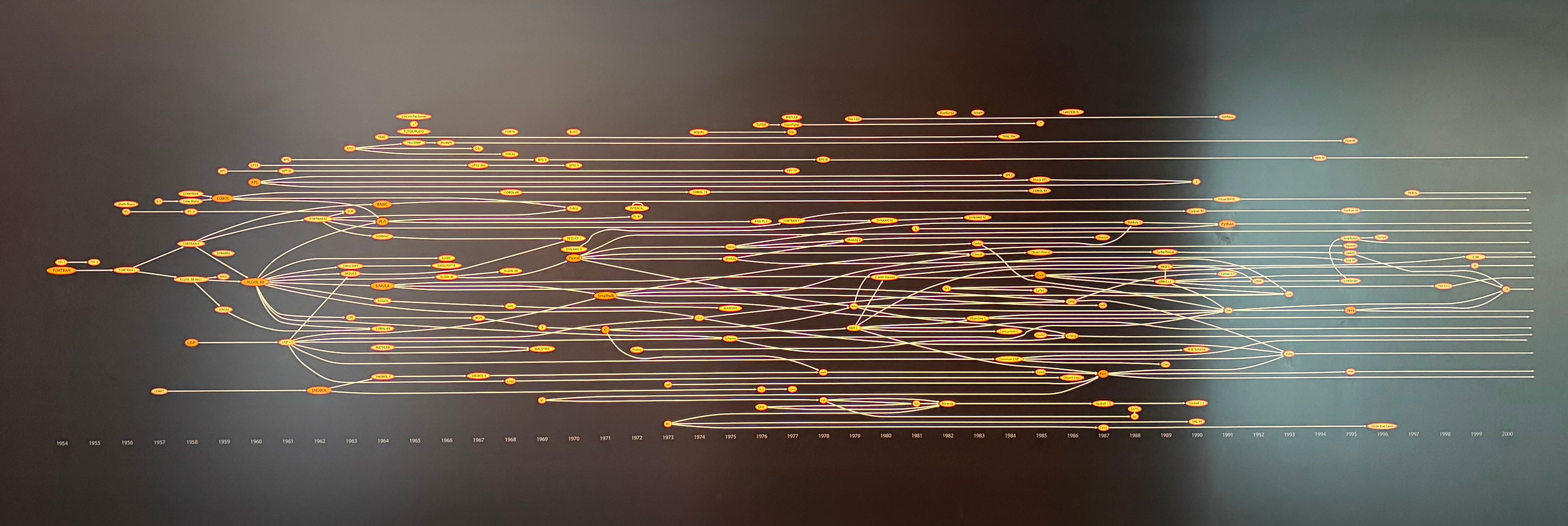
Earlier this year I was on a faculty development trip to Silicon Valley, and we spent a day at the Computer History Museum in Mountain View. It has an enormous, 19-gallery exhibit covering the entire arc of computing—from various kinds of abacuses and punch card readers on one end all the way through early mobile devices (remember Palm Pilots?) and the rise of the internet at the other. I found the section on compilers surprisingly interesting, and I spent a long time studying a wall-length display of dozens and dozens of programming languages, laid out taxonomically—how they branched and evolved and borrowed from one another, all of them attempts to solve the same fundamental problem: how to tell a machine exactly what you want it to do.
I stood there for a long time, and Neil Postman’s famous question—What is the problem to which this technology is the solution?—popped into my head. One of our academic technologists on campus asks it all the time, and it’s a wonderful heuristic for thinking about whether a particular technology is the best way—or even a useful way—to solve a problem.
Postman asked the question in Building a Bridge to the 18th Century (1999), noting that it is important because “there are technologies that are employed—indeed, invented—to solve problems that no normal person would regard as significant” (42). Jane Rosenzweig at Harvard built an entire writing course around a version of it in relationship to AI: To What Problem Is ChatGPT the Solution?
It’s a great question, and to be honest it feels purely rhetorical when you ask it this way—nothing, really?—but standing in front of a wall covered with computer languages, the question hit me differently.
And something clicked.
§
When people in higher education talk about AI, we are much more likely to talk about the problems it creates than the basic problem it solves. And for good reason. AI has scrambled our assumptions about plagiarism, authorship, assessment, student motivation, and the meaning of original work. It has also forced us to think harder about deskilling, misinformation, environmental costs, and the erosion of critical thinking.
One defensive response is containment. More often than not, this takes the form of what Ian Bogost has described as a traditionalist retreat. Faculty’s response to AI has been, in his words, a “shockingly traditionalist interpretation of their role as educators”—think handwritten blue-books and in-class-only writing, laptop bans, proctored exams, and even policies designed to ban AI use across an entire institution. This response isn’t wrong about the problems—I’ve written about several of them in this newsletter. But I worry that containment sidesteps the harder questions about how to teach in a changing world by trying to preserve a world where the AI question doesn’t apply.
Containment makes sense as a response to disruption, and it tells us a great deal about the problems AI creates for education. But it does not answer Postman’s question.
Unfortunately, when we do actually discuss AI as a possible solution to educational problems, the answer is usually couched in the future tense. AI will be able to tutor students at scale with personalized learning. It will be able to grade papers faster against objective criteria. It will be able to generate content and adapt to individual student needs.
These future-tense answers treat education as a delivery problem—too many students, too few instructors, not enough hours—and treat AI as a way to optimize away messy human inconsistencies. So far, these are mostly imagined applications of the technology inside education, not an explanation of why the technology exists or why it has become so disruptive. Notice also that content delivery is just part of education; if it weren’t, the university would have disappeared with the invention of the printing press and the proliferation of books, or at least with the arrival of correspondence courses or online classes.
Both frames miss what’s most important about how AI works and why it has become so disruptive: neither explains what large language models actually do.
§
Here is what I think the answer is.
Let’s return for a moment to the wall of programming languages at the Computer History Museum—all those branching efforts to solve the problem of telling a machine what you want it to do. For most of computing history, that problem was solved in two related ways. Programmers use code to create software, and the rest of us use the software they create. Word processors, spreadsheets, browsers, databases, learning management systems, design tools, email clients, calendar apps—all of these give ordinary users access to the power of computation without requiring us to write the underlying instructions ourselves.
This means that our access is mediated by interfaces that someone else has imagined and created. If the software does what you need, wonderful. If it doesn’t, the normal options are to adapt our work to the tool, hack together workflows across multiple tools, learn to code, or find someone who can write code to build what we need.
LLMs change that relationship in multiple ways. The first radical shift is that anyone can talk to a computer and have the computer respond in ordinary language. That is what made ChatGPT feel so startling when it went mainstream: you could have a conversation with a computer!
From there, the implications quickly expanded. Because you can speak to the machine, you can also ask an LLM, among other things, to explain, summarize, brainstorm, revise, translate, classify, and plan. In addition, since LLMs can code, you can ask them to help you create your own working software, even if you don’t write code. Finally, you can now enable an LLM to control your computer directly, which means that it can do most of the things that you can do, including opening files, clicking buttons, and using software. The chatbot was only the first visible form of a deeper change: natural language is becoming the new interface for using computers.
The blunt truth is that LLMs enable something remarkable: they shrink the gap between the user and execution by a computer to the width of a well-constructed sentence.
Calling LLMs a translation layer is an imperfect analogy, of course. A compiler translates formal instructions according to explicit rules; an LLM performs dizzyingly complex calculations and generates statistically probable responses from learned patterns in language. That makes the interface astonishingly flexible—but also unreliable in ways a compiler is not.
Even so, this is no small shift. It fundamentally changes the computer-human interface. But it has a consequence that the AI-in-education conversation has been reckoning with more intuitively than explicitly: the translation layer rewards expertise, not technical skill. A domain expert with deep knowledge can get extraordinary leverage from this technology. A novice with little to translate gets much less worth having.
The expert’s advantage is partly that they can ask better questions and give better instructions, and partly that they can verify, evaluate, reject, and redirect what comes back. Expertise matters in the front end of the exchange because it shapes the task for the computer, and it matters at the back end because it gives the user a way to judge the quality of the machine’s response.
§
If LLMs are a translation technology, then at least one of the questions professors must ask about their teaching becomes: what do your students have that’s worth translating?
A student with nothing to say—who hasn’t done the reading, hasn’t wrestled with the ideas, hasn’t built the conceptual architecture that makes an argument possible—gets fluent, confident, and often strangely empty prose. They get, in a colloquialism that I’m already starting to find tiresome, “slop.” This is true not because the technology failed, but because there was nothing of any particular value beyond the statistical average of the Internet to translate. Worse, the model will translate the absence of understanding into the appearance of understanding.
A professor with deep pedagogical knowledge, on the other hand, gets the ability to create a spellbook. With a little bit of training and experimentation, they can encode decades of teaching expertise into workflows that evaluate lesson plans, test plans against discussion frameworks, or even check to see if their teaching has fallen into a pedagogical rut. The technology can amplify their expertise, but only because they have expertise to amplify.
This helps explain the inversion I wrote about in an earlier post, in which I argued that AI has upended the hierarchical logic of Bloom’s Taxonomy. If LLMs turn natural language into an action layer for using computers, then students can produce sophisticated-looking work before they have built the foundational skills and understanding that producing such work used to demonstrate.
The question is more complicated, though, than “should students use AI?” I was part of a discussion recently in which someone said that AI is both the greatest tool for learning ever invented and the greatest tool for undermining education we’ve ever had. And it is true that a student who engages with AI seriously, who uses it to push their thinking rather than replace it, can build knowledge in ways that weren’t possible before. But used to avoid doing work, AI is an easy button that short circuits learning. Studies are beginning to bear out these patterns.
In other words, AI can teach you to translate things worth translating, and it can do all the translating for you so you never learn how. The tool is entirely agnostic about which one you’re doing. And it requires intention, and sometimes skill, to know whether you’re using it to learn or to avoid learning.
AI can absolutely help novices when the interaction is designed to ask open questions, preserve difficulty, diagnose misconceptions, offer examples, and keep the student doing the thinking. But consumer AI’s default setting is task completion, not learning. It becomes pedagogical only if and when user intention and the surrounding design make learning, rather than task completion, the objective.
That question—which kind of use is this?—is a question about education rather than technology. It’s a version of the question I keep coming back to in this newsletter: what is education actually for?
§
Postman asked some follow-up questions that can help us here, too, including: whose problem does this solve, what new problems does it create, and what changes in language follow? For AI in education, the answers are unsettling. It solves the expert’s interface problem, creates the novice’s outsourcing problem, and splits writing into at least two activities that we used to treat as one.
There is composing, which I’d define as the slow, difficult, generative work of figuring out what you think by trying to say it. And there is producing text, which is the act of rendering thought into polished prose. AI is already very good at the second. It can produce fluent text almost instantly, even if it has some annoying quirks. The essay mattered as an assignment primarily because it forced students to compose—to read, discover, select, connect, weigh, arrange, and work out the connective tissue of what they actually thought—and secondarily because it helped them learn to write clear, readable prose.
This is why the word writing is becoming unstable. If AI handles text production, then teachers have to become much clearer about when we are assessing the artifact and when we are cultivating the capacity to compose ideas. The translation layer translates. But education has to protect the thinking that precedes the translation, however the text is produced.
§
The automobile is a useful cautionary tale here of a useful, widely adopted, and transformational technology that came with serious (and originally unanticipated) consequences. Postman used it as one of his key examples, and I’ve spent a good part of my career thinking about the world cars made. Americans asked Postman’s first question about the car and got a good answer: it solved the problem of getting easily, comfortably, and quickly from point A to point B. What they didn’t anticipate were the knock-on consequences—the extensive networks of roads required to carry cars everywhere, the traffic, the sprawl, the pollution, the oil-dependence, and the various other problems related to an entire civilization reshaping itself around a single technology. Most significantly, once we committed to the path of making near-universal car ownership “normal,” we built an infrastructure that locked in most of the costs.
We are still very much in the early window of AI adoption. The infrastructure isn’t built, and the costs aren’t yet locked in. We can still ask what this technology should look like and what trade-offs we’re willing and unwilling to make, not least because the infrastructure of AI—whether that’s the physical infrastructure of giant data centers or the ways that it reshapes education—still has many live possibilities. Understanding that LLMs are a natural-language interface that allows us to tap into the enormous power of computers doesn’t make the problems disappear, but it does mean we can think about them, including the most likely negative effects, a little more clearly.
And so my question for you today is: If AI is a translation layer, what do your students have that’s worth translating—and how are you helping them build it?
Hit reply. I’m listening.
Interested in how and why I use AI in this newsletter? Read more here and here.