
The Trouble with Authenticity
“Authentic” has become higher education’s version of “wilderness”—and the purity standard is failing us the same way.

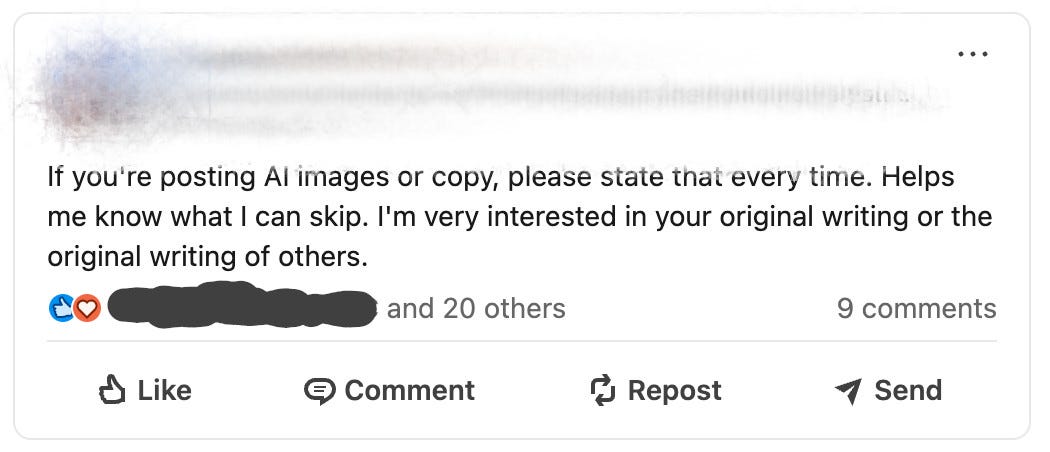
A post crossed my LinkedIn feed recently: “If you’re posting AI Images or copy, please state that every time. Helps me know what I can skip. I’m very interested in your original writing or the original writing of others.”
You’ve probably seen similar posts, usually with a wall of agreement—people tagging friends, sharing to their own feeds, adding variations: I can always tell. It’s obvious. I’m here for real human connection, not robot slop. Believe me, I understand this impulse, and feel that flicker of irritation when something reads like it was pasted straight from ChatGPT. (If you’ve never experienced it while reading a student paper, you can take my word for it that the feeling hits even harder.)
But something about the framing is nagging at me. Not the frustration—the logic. Posts like this are at least nominally asking people to disclose their process, but under the surface what they are really asking is for readers to sort themselves into two categories: authentic or artificial, human or machine, real or fake.
I’ve seen this move before.
§
“Wilderness hides its unnaturalness behind a mask that is all the more beguiling because it seems so natural.” — William Cronon, “The Trouble with Wilderness” (1995)
In 1995, William Cronon published “The Trouble with Wilderness” and turned some basic assumptions of environmental politics on their head. Cronon has had an outsized influence on how I see the world—he co-advised my dissertation—but this essay in particular hit me as a revelation, dismantling an idea I had never once questioned. That belief was that real nature was wild, distant … and somewhere else.
This idea had a history, of course, and Cronon showed how it had been forged by two powerful cultural traditions: a Romantic aesthetics of the sublime that put God on the mountaintop and made untouched landscapes sacred, and a frontier mythology that cast wild land as the crucible of American character. By the late nineteenth century, these two traditions had fused into a single, powerful idea: wilderness was authentic nature.
Dismantling this idea generated controversy (to put it mildly) because it had political implications. For all of wilderness’s very real value, Cronon argued, the attention we lavished on national parks and old-growth forests came at the cost of paying far less attention to the everyday environments in which we spent most of our time. The city park, the backyard garden, the family farm, the urban riverfront—the places where we live and that sustain us—all seemed lesser forms of nature, somehow, than the wilderness.
The irony was that this all-or-nothing logic, followed to its extreme, undermined the very thing it was trying to protect. “From such a starting place,” Cronon wrote, “it is hard not to reach the conclusion that the only way human beings can hope to live naturally on earth is to follow the hunter-gatherers back into a wilderness Eden and abandon virtually everything that civilization has given us.” The powerful public rallying cry was “Save the Wilderness!” But the harmful private echo was “My backyard isn’t Yosemite, so why bother?”
Cronon’s critics accused him of abandoning wilderness, but he loved wild places—that was the point. His actual target was the binary itself: the habit of mind that declared human presence antithetical to nature, the logic that put “the human” and “the natural” on opposite sides of a wall. Once you accepted that frame, any landscape bearing a human fingerprint had already forfeited its claim to our attention—the creek behind the strip mall, the cherry tree your grandmother planted, the wetland at the edge of the subdivision. None deserved the same fierce care as the wilderness.
The essay drew a distinction that often gets lost in the retelling. Wilderness was the cultural mythology—defining nature as pristine, unpeopled, and sublime. Wildness, on the other hand, was something different. Wildness was a word for the autonomy and otherness of the nonhuman world, which is present everywhere, including places we’d rarely think to call “natural.” It “can be found anywhere,” Cronon wrote: “in the seemingly tame fields and woodlots of Massachusetts, in the cracks of a Manhattan sidewalk, even in the cells of our own bodies.”
The real question was what kind of care we owe to the places we actually inhabit. What does it look like to tend a landscape after conquering it and measuring off property lines? A gardener who knows the soil, who reads the seasons, who feels an obligation both to what grows there and to future generations—that person is practicing something the purity standard never learned to value. The backyard garden is not the wilderness. But the garden is not nothing.
§
“This, then, is the central paradox: wilderness embodies a dualistic vision in which the human is entirely outside the natural.” — Cronon
In today’s debates about generative AI, “authentic” has become our wilderness.
Listen for it in any faculty discussion about AI and you’ll hear it everywhere. Is this authentic student work? How do we protect authentic assessment? How do we ensure authentic learning? Everyone nods. But we rarely stop to ask what the word actually means.
Beneath our agreement is an assumption so deep that most of us don’t notice it: authentic means unassisted. Students should sit down, alone with their thoughts and the blank page, and produce every word from scratch. They should be scholars whose ideas spring forth fully formed from their own solitary thinking.
Don’t get me wrong. Just as wilderness has tremendous value, there’s also something inherently valuable in sitting with a difficult problem and working it out yourself. Struggling to compose unruly thoughts into well-formulated sentences really does produce insight. Anyone who has wrestled a paragraph into shape until it finally said what they meant to say knows this in their bones. The purity standard isn’t wrong about the value of that experience.
But it is wrong about everything else.
When “authentic” means “unassisted,” any AI involvement becomes a contamination event. It doesn’t matter whether a student used AI to brainstorm three possible thesis statements before combining the best elements and developing a thesis themselves, or whether they pasted “write me an essay about the Industrial Revolution” and submitted what came back. Both are tainted. The student who carefully shaped an argument in dialogue with a machine, sharpening their own understanding by asking for pushback and counterarguments, and the student who outsourced the whole thing are, under the purity standard, equally suspect. The frame can’t tell the difference, in large part because it wasn’t designed to.
In the wilderness debate, if any human touch disqualified a landscape from being authentic nature, then it didn’t matter whether you were building a community park or putting up a big box store—both were equally fallen. The same logic applies here: if any AI involvement disqualifies intellectual work from being authentic, then thoughtful use and thoughtless use are the same transgression.
But are they?
The purity frame devalues the cultivated forms of intellectual work that have always been central to how people actually think—dialogue, collaboration, editorial feedback, research assistance, working through an idea by talking it out and getting pushback. This is how serious thinking has always been done.
Most important, the frame lets people off the hook. If you can’t guarantee purity—if you can’t be absolutely certain the student never touched a chatbot, never bounced an idea off an AI, never used a tool to test a formulation—then why try to teach good process at all? The standard becomes the enemy of good teaching. And the more impossible the standard becomes, the less anyone tries to meet it, a cycle that should sound familiar to anyone who has watched an environmental regulation collapse under its own rigidity.
§
“The dream of an unworked natural landscape is very much the fantasy of people who have never themselves had to work the land to make a living.” — Cronon
Here’s what I keep coming back to: the purity frame has its uses in situations where the point is to assess students to see what they can do unaided. But outside those bounds, purity doesn’t describe how good writing actually works.
Before ChatGPT launched us headlong into the current AI moment, I published three books—one solo-authored, one edited collection of primary sources, one co-edited volume of scholarship—and a dozen peer-reviewed articles, including a handful that I co-authored with other people. I wrote every single word—except for the ones that a co-author wrote. And except for the ones that various editors suggested, or the ones I wrote that they removed, or the inelegant ones they helpfully rearranged. (The one thing I’m positive I’m responsible for is my copious use of em-dashes, which grew from an infatuation with Bernard Bailyn’s writing early in graduate school, and which you can pry from my cold, dead hands. I have earned my voice and I will use it.)1
I also originated every single idea—except for the ones that came from the extensive historiographies that I engaged (and cited in footnotes), and except for the ones that developed over years as I talked about what I was working on to anyone patient enough to listen—from friends and family to fellow conference panelists and audiences, to students in my classes. And of course I also got ideas from the generous colleagues and anonymous peer reviewers who were kind enough to read my work, engage it thoughtfully, and make extensive suggestions about things as fundamental as structure, argument, and evidence, and as subtle as emphasis, nuance, tone, and exact wording.
We have a standing agreement to accept that this sort of help is a normal and expected part of a good writing process. We offer our profuse but usually imprecise thanks for the enormous contributions of others in our acknowledgments section, or in a footnote, and proceed with the useful fiction that every word and idea published under our name is entirely our own.2
The unassisted blank page is a special case, not the norm. It’s also rarely the whole story about any piece of writing. Insisting on it as the sole arbiter of what constitutes authentic intellectual work would mean that most of the intellectual work humans have ever done doesn’t qualify.
§
“The tree in the garden is in reality no less other, no less worthy of our wonder and respect, than the tree in an ancient forest that has never known an ax or a saw.” — Cronon
So what replaces purity?
Judgment. Not “did you do it alone?” but “were you the one deciding what mattered?” and “is it good?” and “how do you know?”
The tree in Cronon’s garden can be understood the same way. A cultivated landscape requires more knowledge than a wilderness, not less—the gardener must have knowledge of soil, of seasons, of what grows where and why, of when to intervene and when to step back. The gardener is engaged through care, through sustained attention, through everyday decisions about what to cultivate and what to cut.
The same idea applies even when our tools get more powerful. I’m a hobbyist woodworker, so I’ll take that as an example. A woodworker with a table saw hasn’t stopped doing woodworking, whatever the hand tool purists say. The saw can rip a board in seconds that would take twenty minutes by hand. But the woodworker still chooses the joint, reads the grain, designs the piece, and adjusts when the wood doesn’t cooperate. The skill to use hand tools is different from the skill to use power tools, but both are skills, and both can produce work ranging from sloppy to superb. The power saw is powerful. The craft is in knowing what to do with it.
And here I blanch, knowing that I am wading into a sticky debate, but feel compelled to think through what this might mean for AI and writing. Annie Dillard, who spent a career thinking about what writing demands, reached a blunt conclusion about what to share with readers: “Process is nothing; erase your tracks,” she wrote in The Writing Life. “The path is not the work.” And elsewhere: “How many gifts do we open from which the writer neglected to remove the price tag? Is it pertinent, is it courteous, for us to learn what it cost the writer personally?” In other words, asking an expert woodworker (or writer) if they used a certain tool is the wrong question. The right one is if they were exercising judgment when they used it: about what matters, about what “good” looks like, about what the work is for. For expert writers (and woodworkers), this and the quality of the finished piece are all that matter.
The power saw is powerful. The craft is in knowing what to do with it.
But for students, who are still developing expertise and the discernment that comes with it, the path is in fact the work. And here shop class offers a potentially useful metaphor, in part because whatever our desire to leave the dangerous tools locked in the cabinet, that is not how students learn. Students need an orientation to the tools and how they work. They need to know why some mundane operations, performed incorrectly, can take off a finger or turn a piece of wood into a deadly projectile. Shop class must teach the hand tools and the power tools. These days it also has to teach 3D printers and CNC routers and computer aided design. But it still must teach students how to read the grain—because you can’t evaluate what a machine produces if you don’t understand what the material demands.
Teaching writing in this age of AI demands the same kind of shift. The interesting question—the one the purity frame can never ask—is whether students are developing the judgment to wield these powerful new tools well. Can they tell when a counterargument is weak? Can they recognize when a paragraph lacks human voice, or when something looks right but isn’t? (Notice that these problems, which are suddenly more common because of AI, are not actually specific to AI.) That’s what we should be teaching: the discernment to know what they want to say, the skill to recognize when they’ve gotten it, and the honesty to know when they haven’t.
That’s the cultivated landscape. That’s the piece of heirloom furniture. That’s the craft of writing. They all require skill and care. They require you.
§
I think of that social media post and all I see is the questions it doesn’t allow: Did you exercise judgment? Did you know what you wanted to say before you opened the tool? Could you tell when the result was wrong? Did you create something beautiful, or worthwhile, or thought-provoking? The purity frame doesn’t allow those questions. It has only two categories—real or fake, wilderness or wasteland, original or slop—and the harder, more interesting questions live in the space between.
The garden is not the wilderness. But the garden is not nothing.
Am I wrong? Can we honor the unaided encounter with the blank page without insisting it’s the only encounter worth having?
Hit reply. I’m listening.
Interested in how I use AI in this newsletter? Read more here.
This is the point when the normal Substack move would be to tell you that, of course, I have not used AI to write any of the words in this essay because I am using this space to work out my ideas, which means (purity frame) touching AI would contaminate the process. That move would undermine my argument and I won’t offer that assurance; instead I will say: If the writing or argument here feels robotic, or if you believe that I have lacked discernment in sharing my ideas, then I have failed as an author, whatever tools I used, and you should abandon ship.
Speaking of which: Thanks to the folks who read this essay in advance and offered feedback and advice!
This was a phenomenal frame to look at AI writing through, and perhaps the first time that I've read commentary on this issue that has introduced any nuance to the matter that felt compelling to me. I am not a teacher but I was, until very recently, a student and a writing tutor, and I agree on principle that the garden is still worth considering despite it not being the wilderness. I do think that considering peer review involves a level of discernment that most student writers are not being taught or incentivized to employ or when using AI. At the same time, I can't help but be a little bit of a purist — AI has never given me the kind of personal, life-changing feedback that real people have. Much to think about! Thanks for the great essay!
Your wilderness/authentic frame, and the purity/corrupt binary, instantly made me think of Donna Haraway's Manifesto for Cyborgs. I appreciate this nuanced shift in thinking about AI. We all have to examine our hidden logic and desires.
I still think many of us could argue that to acquire the discernment that you identify as the better question than tech v. purity in fact requires much time away from AI. Not necessary alone in some monk's ascetic cell (they had community!). And we can debate whether the use of "grammar/spell check" and more active AI roles "counts." But still, like multiplication tables or foreign vocabulary or reiterations of a sentence, a student has to invest their own time and labor to learn 'the wisdom to know the difference.' We all have noted that the students lack the judgement that more senior people achieved without AI. Because it without AI, is the understanding.